
Cars and small SUVs
Everyday hatchbacks, saloons, estates and compact SUVs make up most of our recovery work, whether they will not start, will not drive or are simply not safe to continue in.
24/7 Emergency Roadside Assistance
Breakdown recovery • Warwickshire
24 hour breakdown recovery, towing and vehicle transport across Leamington Spa, Warwick and the wider Warwickshire area. Cars, vans, motorbikes and non-runners moved safely to wherever they need to be.
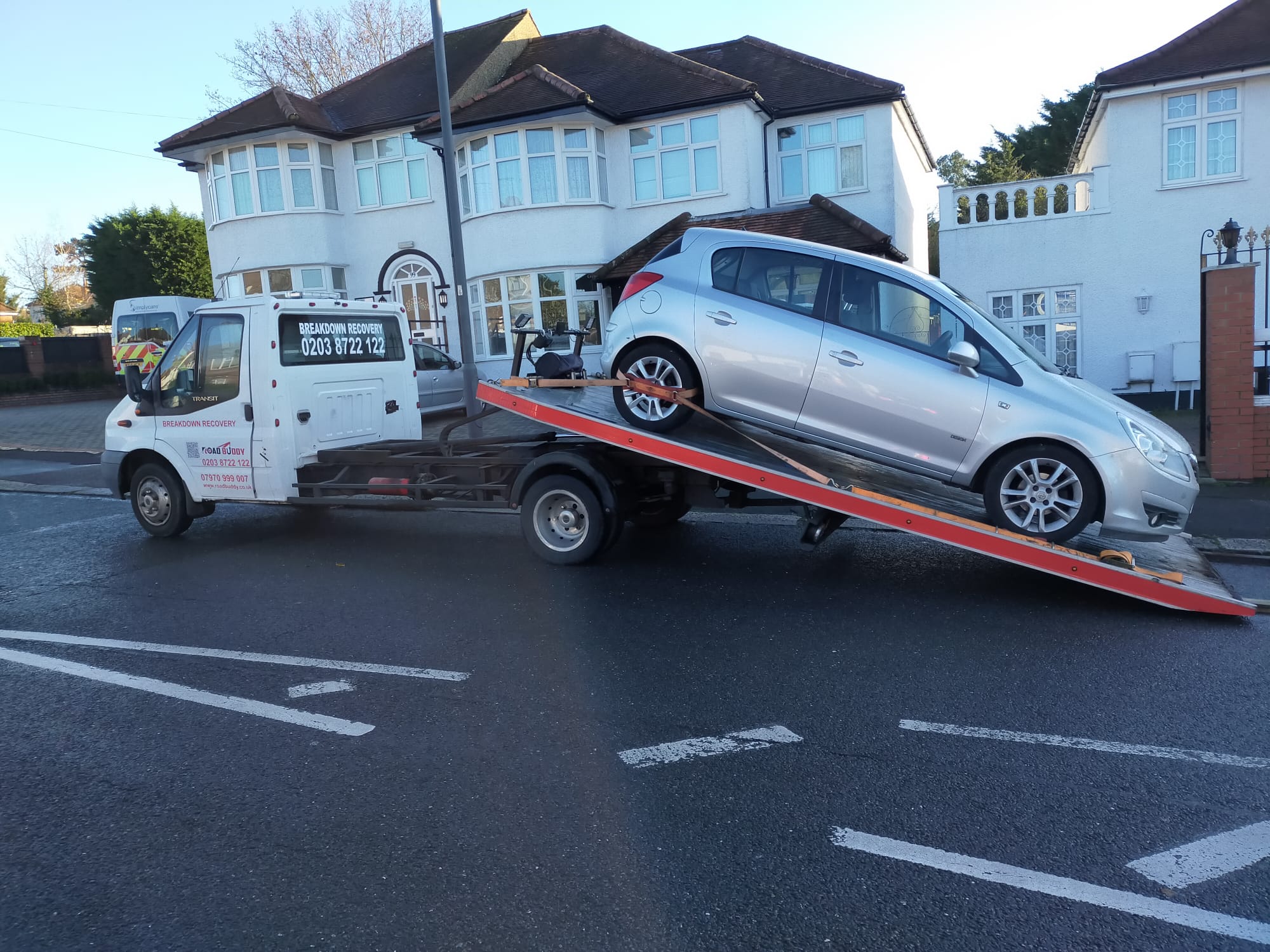
When a vehicle stops, the first thing most people do is search for recovery near me or tow truck near me and hope somebody local answers. Road Buddy is that local answer. We are based in Leamington Spa and we cover Warwickshire and the roads around it, so when you call you are speaking to people who already know the junction, the lay-by or the estate road you are describing.
A great deal of what we do is not towing at all. A puncture, a flat battery or a simple fault can often be sorted where the vehicle sits, and that is almost always cheaper and quicker for you than moving it. Recovery is the right answer when the vehicle cannot be made safe to drive — and when that is the case, we load it properly and take it where you need it to go.
This page explains the whole picture: what a towing service actually involves, when you need a recovery truck rather than a roadside repair, how a car transporter differs from an emergency tow, and what we need to know before we set off. If you would rather just talk to somebody, call us — that is usually the fastest route to an answer.
Vehicles do not fail politely between nine and five. A large share of our work happens on dark winter mornings, late on a Friday and over bank holiday weekends, which is exactly why we run a 24 hour recovery line rather than an answerphone. Somebody picks up, asks the right questions and tells you what happens next.
What we will not do is invent a time. 24 hour breakdown recovery means the phone is answered around the clock; it does not mean every vehicle in the county can be reached in the same number of minutes. How quickly we get to you depends on where you are, what is already running and what the roads are doing. When you call, we give you a realistic answer and we update you if it changes.
Night work also changes the job itself. Visibility is worse, drivers are less predictable and cold weather turns a marginal battery into a dead one. If you are waiting after dark, keep your hazard lights on where appropriate, wear something high-visibility if you have it, and wait somewhere away from live traffic rather than in the driver's seat.
People type car recovery near me and car towing near me at the worst possible moment, usually standing on a verge with the hazards ticking. The reason local matters is simple: distance is the biggest single factor in both how long you wait and what the job costs. An operator based in the county is nearly always the better call than one dispatched from the other side of the region.
Typical car recovery jobs look like this — an engine warning light that turns into a limp home mode, a clutch or gearbox that gives up on a hill, an overheating engine that must not be driven any further, a car that will not turn over in a supermarket car park, or a mis-fuel that means the engine must not be started at all. In each case the goal is the same: get the vehicle and the people away from the traffic and on to somewhere sensible.
Where the fault is genuinely roadside-fixable we will say so. A flat tyre often means mobile tyre fitting rather than a tow, and a dead battery often means a battery replacement or a jump start. Recovering a car that only needed twenty minutes of work at the kerbside serves nobody.
Vehicle recovery near me is a broader search than car recovery, and rightly so — the same principles apply to vans, motorbikes, non-runners and vehicles that have never turned a wheel in years. What changes from job to job is the loading method, the restraint equipment and how much space there is to work in.
The three things that decide how a recovery is done are access, condition and weight. Access is whether there is room to position the truck, deploy ramps or a winch line and get the vehicle out safely. Condition is whether it rolls, steers and comes out of park or gear. Weight and dimensions determine what equipment is suitable at all. That is why we ask questions on the phone instead of guessing.
Multi-storey car parks, narrow lanes, verges and private driveways all change how a vehicle can be lifted or loaded.
Whether the vehicle rolls, steers and releases its parking brake decides between a drive-on load and a winch.
Straps and restraints appropriate to the vehicle, checked before moving and re-checked en route.
You speak to the same local team from the first call through to handover at the destination.
Home, your own garage, a bodyshop, a dealer or a storage address — you choose before we load.
If a vehicle is not something we can safely move on the day, we say so and point you in a sensible direction.
Searches for a tow truck, towing near me or truck towing near me usually mean one of two very different things. Sometimes people mean a genuine tow, where a towing vehicle pulls a casualty on a rigid bar or spectacle lift. More often they mean transported recovery, where the vehicle is loaded onto a bed and travels with all four wheels off the ground.
Which is appropriate depends on the vehicle. Many modern cars — particularly automatics, four-wheel drives and vehicles with electronic parking brakes or electric drive components — should not have driven wheels turning on the road while being moved, because it risks damage to the transmission. Where there is any doubt, transported recovery on a bed is the safer choice and the one we will normally recommend.
A proper towing service is also about what happens either side of the journey. Getting the vehicle out of a tight bay without touching the car next to it, protecting a low front bumper on the ramps, and unloading somewhere the receiving garage can actually work on it are all part of the job — not afterthoughts.
A recovery truck and a service van do different jobs, and knowing which one you need saves everybody time. When somebody searches for a recovery van near me or a recovery vehicle near me, what they usually want is whichever unit solves the problem in one visit.
Our service van is the roadside repair unit. It carries tyre equipment, battery testing and replacement stock, jump starting equipment and general tooling, and it is what turns up when the fault has a realistic chance of being fixed where the vehicle stands. That is automotive towing near me avoided altogether, which is the best possible outcome.
Recovery equipment is what we arrange when the vehicle has to move. Loading a casualty safely needs the right bed or lift, winching capability for non-runners, and enough clear space to work. When you call, describing the surroundings — kerb height, overhead barriers, width restrictions, whether it is on a slope — lets us bring the right thing first time.
Fix it where it stands
Roadside assistance and breakdown recovery are not the same service. The first tries to get you driving again; the second moves the vehicle when that is not possible.
Roadside assistance near me is the search to make when the vehicle has a specific, identifiable problem — a puncture, a flat battery, a lost locking wheel nut key, a car that cranks but will not fire. Our approach is to attempt the repair first, because a successful roadside fix means you drive away rather than waiting for transport and then arranging a way home.
There are clear limits, and we are straight about them. Anything involving suspected engine or transmission damage, brake failure, serious fluid loss, structural damage or a fault that cannot be diagnosed safely at the kerbside is a recovery job, not a roadside repair. Attempting to nurse a vehicle home in that state is how a repair bill doubles.
We also provide roadside recovery near me as a combined service: we attend, assess, attempt the repair where sensible, and recover if it is not. You are not paying twice for two separate call-outs because somebody guessed wrong over the phone.
After a collision, people come first. Check for injuries, call 999 if anyone is hurt, if the road is blocked or if there is any immediate danger, and follow what the police or emergency services tell you. Nothing about moving a vehicle matters until the scene is safe.
Once the scene is under control and the authorities are content for the vehicle to be moved, we can attend to recover it. Whether we can do so depends on the extent of the damage, whether the vehicle still rolls and steers, where it has ended up and how much access there is. Damaged vehicles frequently need winching rather than driving onto a bed, and sharp debris and leaking fluids change how the job is approached.
We are a recovery operator, not an emergency service, an insurer or a highway authority. If your insurer or an accident management company is handling the incident, they may have their own arrangements — it is worth checking before instructing anybody, so you know who is paying for what.
A van off the road is usually a business stopped, so van work gets treated with the urgency it deserves. Whether a particular van can be recovered depends on its size, its weight, whether it is loaded and the access at both ends — a car-derived van in a supermarket car park and a fully loaded long-wheelbase panel van on a farm track are very different propositions.
Tell us the make, model and rough load when you call. If the van is carrying stock, tools or materials, we will talk through whether it needs unloading first, since weight and load security both affect what is safe to move. If it is a lease or contract vehicle, check whether the leasing company has its own recovery arrangements before instructing us.
Plenty of van call-outs never need recovery at all. Commercial tyres and heavily loaded vehicles are hard on batteries and rubber alike, and van tyre work or a battery replacement at the roadside often has the vehicle earning again the same morning.
Motorbike recovery is a specialised part of the job and it is nothing like loading a car. A bike has no parking brake to hold it, no natural anchor points on the bodywork and a very narrow footprint, so it needs a chock or a dedicated rail plus soft straps run through points that will not bend or scratch.
Before we attend we will ask what the machine is, whether both wheels turn freely, whether the steering is intact and whether it has been dropped. A sports bike with a seized rear wheel, a heavy tourer and a scooter with a flat battery each need a different approach. Where a suitable method is not available for a particular machine on the day, we will tell you rather than risk damaging it.
Riders are also more exposed while they wait. If you have gone down or come to a stop on a fast road, get yourself off the carriageway and behind a barrier if there is one, keep your helmet on until you are clear of traffic, and make the bike as visible as you safely can.
A car transporter job is planned rather than reactive. Nobody is stranded, there is no traffic to manage and the vehicle is often perfectly driveable — the owner simply does not want to, or cannot, drive it. Booking ahead means we can pick a sensible time and give you a settled price on the route.
Typical services car transport requests include a car bought at auction or from a private seller, a part-exchange going back to a dealer, a classic or track car that should not be doing motorway miles, a vehicle without current tax or MOT that cannot legally be driven, and movements between a garage and a bodyshop.
Loading a low or valuable car on a bed is where the care shows. Approach angles, ramp extensions, strap placement and where the vehicle sits on the deck all matter, and a two-minute conversation about ride height before the day beats an improvisation on a wet driveway. Photographs of the vehicle and both addresses are genuinely useful.
A car delivery service is vehicle transport viewed from the other end: instead of collecting a casualty, we are delivering a vehicle to a customer, a buyer or a business. The mechanics are the same, but the expectations are different — a car delivery arrives clean, on time and to somebody who is waiting for it.
We handle deliveries for private sellers and buyers, small independent dealers, garages moving vehicles between sites and people relocating a second car. For a delivery we need both full addresses, a contact at each end, whether the vehicle starts and drives, whether keys travel with it, and any access restrictions such as a height barrier, a private road or restricted parking.
Where the vehicle is not driveable, delivery becomes a transport job rather than a drive-away, which affects timing and price. It is far better to establish that when you book than for a driver to discover it in the middle of a collection.
Cheap car recovery is one of the most common searches we see, and it is an entirely reasonable thing to want. What people are really asking for is not the lowest number on the internet — it is a fair price, known in advance, with nothing added afterwards.
Recovery pricing is driven by distance, the vehicle, the time of day, access at both ends and what the job actually involves. Loading a rolling hatchback from a level car park is straightforward. Winching a seized non-runner out of a rutted driveway at three in the morning is not, and it would be dishonest to pretend the two cost the same.
Our approach is simple. You describe the job, we ask the questions that change the answer, and we give you a clear price for that work before anyone sets off. If something on arrival turns out to be materially different from what was described, we talk to you about it rather than quietly adding it to the bill. And where a roadside repair would be cheaper than car recovery rapid transport, we will tell you that too.
A clear figure for the job as described, agreed with you on the call.
If the job on the ground differs from the description, we discuss it before continuing.
Where a roadside fix is realistic, we say so — it is usually the cheaper outcome.
A non-runner is any vehicle that will not start, will not move under its own power or cannot legally be driven. It might be a project that has sat under a cover for five years, a car with a seized engine, an untaxed vehicle being moved to storage or something that simply refuses to turn over on a Monday morning.
The questions we ask are always the same, because they decide the method. Does it roll? Does the steering unlock? Can it be taken out of park or gear? Are the tyres inflated? Is there room in front of or behind it to pull it out? A vehicle with four flat tyres and a locked steering column in a tight garage is a very different job from one sitting on a driveway.
Photographs help enormously here — one of the vehicle, one of the space around it and one of the route out. Two minutes with a phone camera regularly saves an hour on site and avoids a wasted visit.
Safety first
On motorways and high-speed roads, the instructions of the highway authority and the emergency services always come before anything a recovery operator says.
If you break down on a motorway or a smart motorway, your priority is getting away from live traffic. Where you can, leave at the next exit or reach a designated emergency area. If you have to stop, pull as far to the left as possible, put your hazard lights on, leave by the nearside doors and get behind the safety barrier where there is one. Do not attempt repairs on the carriageway, and do not stand between your vehicle and oncoming traffic.
Use an emergency roadside telephone if you can reach one safely, because it identifies your location automatically. Otherwise call 999 as directed where there is danger, an injury or an obstruction. Follow whatever the operator tells you, including if they instruct you to stay in the vehicle with your seatbelt on because it is not safe to get out.
Road Buddy does not replace the emergency services or the highway authority and has no authority of its own on the motorway network. Where the authority permits a private operator to attend and recover the vehicle, contact us and we will tell you what we can do and when.
Away from the motorway the same principles scale down. Stop in the safest available place rather than the nearest — a lay-by, a side road or a car park beats a bend or the brow of a hill. Use hazard lights where appropriate, particularly in poor visibility. Keep passengers and pets away from the carriageway, and if children are with you, get everyone to a verge or footway on the safe side of the vehicle.
If the vehicle is blocking a junction, a level crossing or a lane and cannot be moved, that is a 999 call, not a recovery call. Get help to make the road safe first; we can deal with the vehicle afterwards.
A lay-by, side road or car park is far safer than a bend, a brow or a live lane.
Hazard lights where appropriate, sidelights at night, and high-visibility clothing if you have it.
Leave by the nearside where safe and wait behind a barrier or on a verge, not in the driver's seat.
Immediate danger, injury or an obstruction is an emergency call before it is a recovery call.
Tyres cause more roadside stops than anything else, and most of them do not need a recovery truck. Roadside tyre repair is possible where the damage is a small puncture within the repairable area of the tread and the tyre has not been driven on while flat. Anything in the sidewall or shoulder, any sign the tyre has run flat, and any cut or bulge means replacement rather than repair.
Where a repair is not appropriate, roadside tyre replacement near me is usually the fastest route back on the road — a matching tyre fitted and inflated where the vehicle sits. Our mobile tyre fitting service explains what we carry, how run-flats and locking wheel nuts are handled and what to do about a missing spare.
Recovery only enters the picture when a tyre cannot safely be dealt with at the location — for example on a narrow carriageway with nowhere to work, where the wheel or hub is damaged as well, or where two or more tyres have gone. In that case the vehicle is moved somewhere the work can be done properly.
Before you call
Have these to hand and the call takes two minutes instead of ten. Make yourself safe first — everything else can wait.
A phone location pin, a what3words reference or a marker post number is far better than a road name.
Tells us the size, weight and likely loading method before anyone sets off.
Warning lights, noises, smells, whether it stopped suddenly or would not start at all.
Decides between a drive-on load and winching, and whether extra equipment is needed.
Public road, motorway, private land, multi-storey or a farm track — access changes everything.
Home, your garage, a bodyshop or a storage address, plus who will be there to receive it.
Photographs are the single most useful thing you can send. One picture of the vehicle, one of the space around it and one of the route out tells us more than a long description. Send them on WhatsApp with your registration and we can plan the job properly before we leave.
Step by step
From the first call to handover at the destination, so you know exactly what happens next.
Stop in the safest available place, put your hazard lights on where appropriate and move away from live traffic if it is safe to do so. If there is immediate danger, an injury or the vehicle is obstructing traffic, call 999 first.
Ring the office, send a WhatsApp message or use the contact page. Tell us where you are, what has happened and what the vehicle is doing. A location pin from your phone is worth more than a street name.
Not every breakdown needs towing. We work out from your description whether a roadside repair is realistic, or whether recovery is the sensible answer, and we tell you which we think it is before anyone sets off.
You get a clear price for the work discussed, based on distance, vehicle, access and what the recovery actually involves — agreed with you before we attend rather than presented afterwards.
If it is a roadside fix we carry out the work where the vehicle sits. If it needs moving, the vehicle is loaded and secured properly and taken to the destination you have agreed with us.
We unload at your garage, home, workplace or storage address, hand over keys and paperwork as arranged, and confirm anything the receiving garage needs to know about how the vehicle behaved.
Suitability
What we can move on any given day depends on the vehicle, its condition, the access and the equipment the job needs. Tell us what you have and we will confirm.
Everyday hatchbacks, saloons, estates and compact SUVs make up most of our recovery work, whether they will not start, will not drive or are simply not safe to continue in.
Car-derived vans through to larger panel vans, subject to size, weight, load and access on the day. Tell us the model and whether it is loaded when you call.
Motorbike recovery uses different restraint equipment to a car, so we confirm the machine, its condition and whether it rolls before attending.
Vehicles that do not start, do not steer freely or have been off the road for a long time. Winching may be needed, so we need to know in advance.
Once the scene is safe and the emergency services or highway authority are content for the vehicle to be moved, we can recover damaged vehicles subject to the extent of the damage and access.
Low or delicate vehicles usually need a recovery truck car transporter and careful loading. Ramps, approach angles and ground clearance all matter, so send photos if you are unsure.
Electric and hybrid vehicles, heavily modified cars and anything unusually large or heavy are handled case by case. There are real technical constraints around how such vehicles should be moved, so rather than make a blanket promise we will ask about the specific vehicle and tell you honestly whether it is something we can take on.
Coverage
Warwickshire is our home patch. These are the towns we work in day in, day out.
Our home town. Breakdown recovery Leamington Spa work covers the town centre one-way system, Sydenham, Lillington and the Old Town.
Car recovery Warwick calls range from the town centre and Emscote Road to Warwick Parkway and the Budbrooke estates.
Breakdown recovery Kenilworth and the A46 corridor between Warwick and Coventry, including the Thickthorn junction.
Breakdown recovery Coventry and vehicle recovery Coventry across the ring road, Canley, Tile Hill and the southern suburbs.
Car recovery Rugby and roadside assistance Rugby, including the A426, the M6 J1 approaches and the Dunchurch road.
Vehicle recovery Nuneaton across the town, Attleborough and the A444 towards the M6.
Car recovery Bedworth and the corridor between Nuneaton and north Coventry.
Breakdown recovery Stratford-upon-Avon, the Birmingham Road and the surrounding south Warwickshire villages.
Roadside assistance Alcester and the A46 and A435 routes towards Evesham and Redditch.
Car recovery Southam and the rural A425 and A423 routes towards Banbury and Daventry.
North Warwickshire cover along the A5 and the villages between Atherstone and Nuneaton.
Breakdown recovery Redditch on the Worcestershire border, subject to distance and availability.
Alongside the towns, a lot of breakdown recovery Warwickshire work happens on the roads between them: the M40 corridor past Warwick, the A46 between Stratford-upon-Avon and Coventry, the A45 and A5, and the rural lanes where a phone location pin is worth ten minutes of explaining. If you are searching for breakdown recovery near me anywhere in the county, we are almost certainly the closest sensible call.
We are also regularly asked about towns just over the border — Banbury, Birmingham, Solihull, Hinckley, Daventry, Northampton, Leicester, Evesham, Worcester, Shipston-on-Stour. Those are reachable by arrangement rather than standing coverage, and longer transport runs are quoted individually. Rather than claim a county we do not work in, call and ask: we will give you a straight yes or no, and if it is a no we will not waste your time.
Related services
Recovery is one part of what we do. Most call-outs start as something smaller.
Punctures, blowouts and roadside tyre replacement at your home, work or the roadside.
Battery supply and fitting including stop-start, AGM, EFB and van batteries.
A professional jump start plus charging checks, so you are not back in the same position tomorrow.
You can see the kind of work we take on day to day on our recent jobs pages, browse the towns we work in on the locations pages, or contact the team if you would rather ask a question before booking anything.
Recovery FAQs
The questions we are asked most often about breakdown recovery, towing and vehicle transport.
If you are unsure whether your situation needs roadside assistance, recovery or a planned transport booking, ring us and describe it. Working that out is our job, not yours, and it costs nothing to ask.
Make yourself safe first, then call Road Buddy, send your location on WhatsApp or use the contact page. Tell us where you are, what has happened and where the vehicle needs to go — we will take it from there.
Cars, vans and motorbikes — subject to vehicle, access and equipment.